

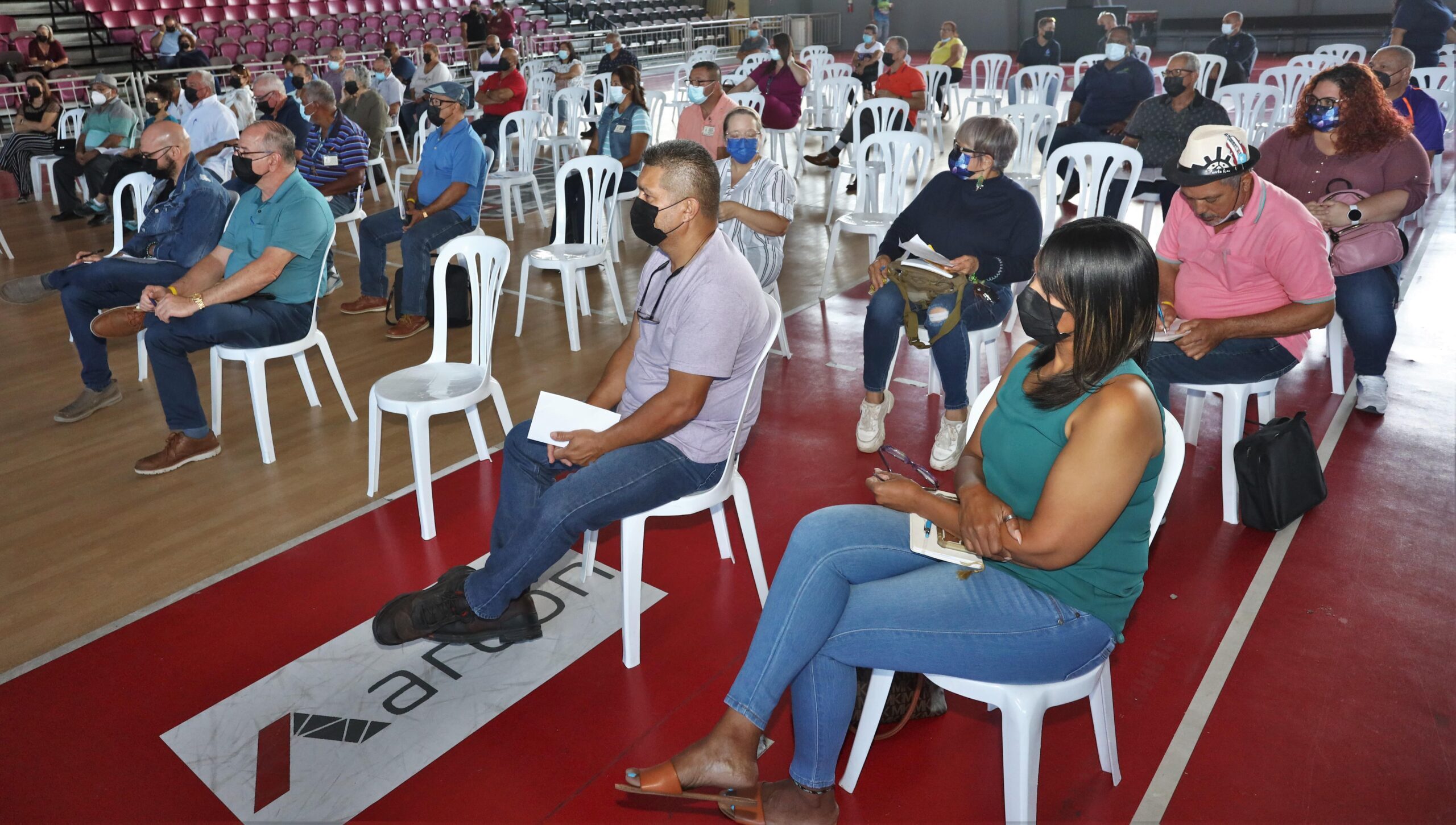
Ponce | Saturday, May 14, 2022 | Communities from four regions of the island gathered today to formalize the Puerto Rico Association of Community Aqueducts Inc. during its first assembly, held at the Salvador Dijols Coliseum in Ponce, where its first board of directors was elected. The new organization will represent the interests of the communities that manage community drinking water systems in Puerto Rico, located mostly in rural and mountainous areas, and which are not connected to the Puerto Rico Aqueduct and Sewer Authority (Prasa).
The establishment of the Association, in this great event, is the result of a series of meetings in which more than 60 community aqueducts have participated, which have taken place since 2019, facilitated and supported by the Puerto Rico Community Foundation (PRCF).
“We finally achieved the task of bringing together the community aqueducts at the island level in this national organization, which did not exist. Now, the board of directors intends to select the national board to begin executing its mission and vision, which in a nutshell, is to strengthen community aqueducts,” said Ivette Ortiz of El Acueducto Pedro Calixto, Inc. Corporation, in Caguas, one of the eleven people selected to join the Association's board of directors.
The persons selected to serve on the board of directors were: Perseverando Díaz and Feliciano Santiago of the San Diego aqueduct in Coamo; Arturo Chévere of Pozo Azul in Ciales; Joseé Ríos and Ivette Ortiz of the Pedro Calixto Aqueduct in Caguas; Carmelo Colón of the Limones aqueduct in Orocovis; Juan Irizarry of the Caonillas Aqueduct in Utuado; Ramón Vega of the Nuevas Parcelas Aqueduct in Cañaboncito in Caguas; Domingo Figueroa of the Mamey Aqueduct in Patillas; Evelyn Rosado of the Humatas Aqueduct in Añasco; and Iris González of the Corcovada Aqueduct in Añasco.
The assembly was attended by 62 people from 32 communities, located in central, south-central, southwestern and southeastern towns: Ciales, Coamo, Caguas, Orocovis, Utuado, Patillas, Añasco, Ponce, Barranquitas, Adjuntas, Yauco, San Germán, Jayuya, Aguas Buenas, Cidra, Naranjito and San Sebastián.
There are approximately 242 community aqueducts in Puerto Rico, located in 43 municipalities. These supply drinking water to 3% of the population, which represents approximately 120,000 people. On a daily basis, these communities face challenges related to the lack of energy to operate the pumping system, contamination of the water bodies that nourish them, and lack of budget to keep them operating in optimal conditions, in order to meet the demand of their communities. The boards of directors of these aqueducts are in charge of the management, administration and management of these drinking water systems.
The national association seeks to unite and amplify the voice of community aqueducts and also to serve as a bridge and facilitate learning and experiences among the members of this community. It also seeks to strengthen the self-management and future sustainability of these community infrastructures to face challenges, make visible their contributions to the communities they serve, share experiences, identify efficiencies and have representation before the government agencies that regulate them. The Association was registered with the Department of State in April of this year.
“Today is a day of celebration because we have achieved a goal that promises to strengthen our aqueducts. We want to make visible the vital role we play in our communities and become a force that facilitates solutions and opportunities that guarantee access to safe and constant drinking water in our communities,” said Iris González of the Corcovada community in Añasco.
After Hurricane Maria, the FCPR developed the Water for Us Program to strengthen the administration, infrastructure, community organization and compliance of the aqueducts, recognizing that they play a vital role in providing access to potable water to their communities. In addition to grants and technical assistance, the FCPR facilitated regional meetings with aqueducts to discuss challenges and knowledge, and these identified the need to formalize a national organization that brings together all community aqueducts on the island. Subsequently, other regional meetings were held in 2021, where delegates were elected from the regions where there are community aqueducts: center, center-south, southwest and southeast, who will be present at the assembly -these delegates have been the driving force behind the assembly.
“History is being made today because the social capital of these communities has been strengthened with the creation of a national body, created under the principles of participation, representativeness and sustainability, which becomes their representative before the country,” said FCPR Vice President of Programs and Administration David Haddock. “Community aqueducts are one of the best examples of self-management and resilience in our communities. For decades, these organizations have individually taken on the arduous task of providing access to clean water in their communities. Joining together will allow them to share knowledge, support each other, and advocate with one voice for better resources and opportunities with public and federal entities,” Haddock added.
The development of the Association is supported by Global Giving and responds to FCPR's mission to achieve community transformation through the increase of community capital; this partnership mainly increases social capital - the rest of the capitals are: human, financial, infrastructure, ecological and cultural.