

Communiqué generated by the Network for the Rights of Children and Youth | Our contribution to this project was through the Dr. Mario Juliá and María Luisa Saldaña de Juliá Fund (emotional services).
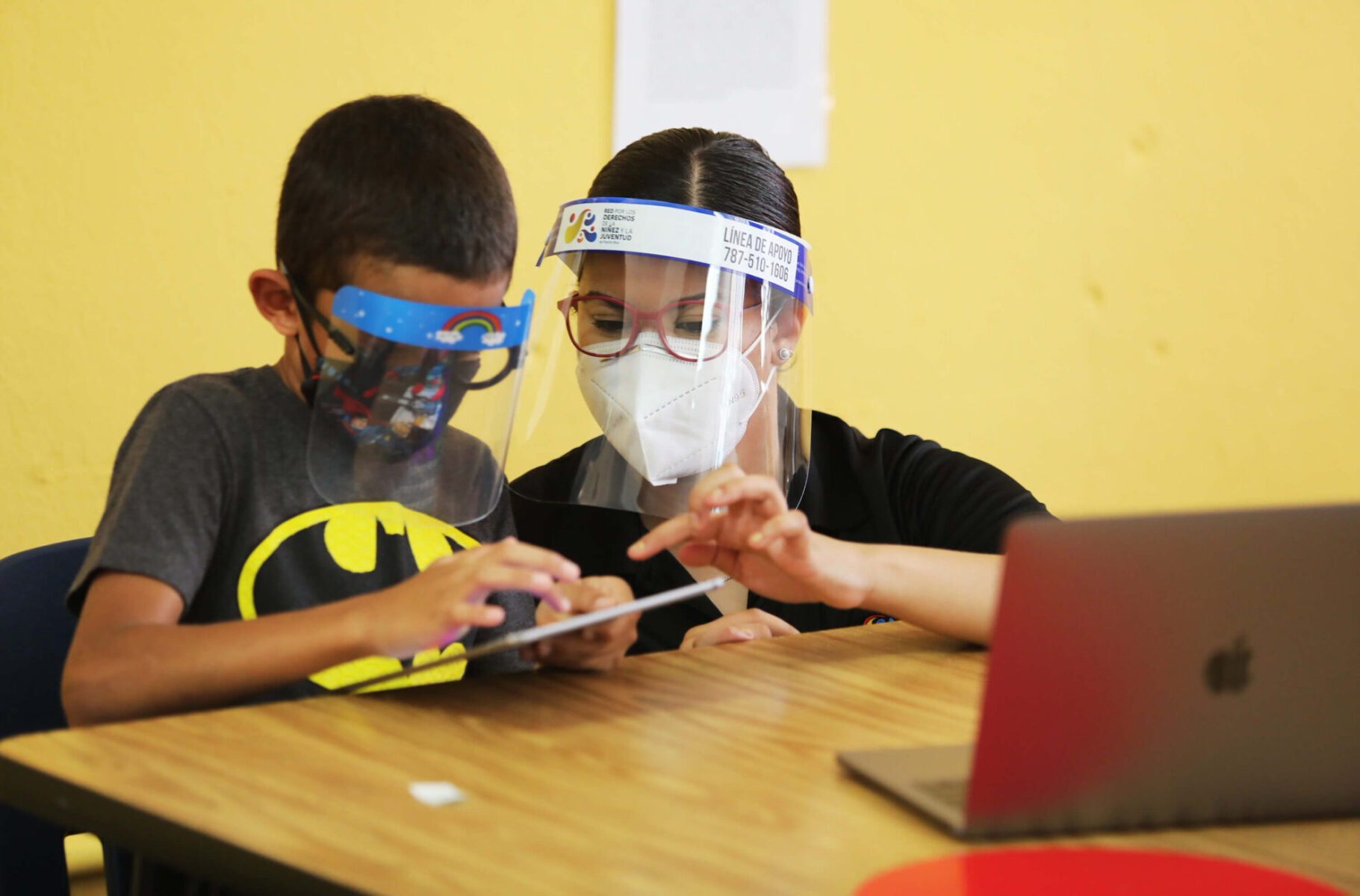
Juncos, Puerto Rico- A technology access center was inaugurated today at Casa Ramón, in Juncos, with the purpose of breaking the technological gap for distance education for children and young people with limited resources. This project of the Network for the Rights of Children and Youth will provide broadband internet and educational resources to some 50 students from the Las Piñas neighborhood in Juncos.
“With Covid-19 closing schools, we saw that many children's education was being affected, adding to parents” anxiety. A 75% of families of children in public schools live below the poverty level. Distance education is a problem for them because 44% of these households have no internet access and 35% have no computers, according to census figures. This center at Casa Ramón will provide educational alternatives for the community's children," explained Marcos Santana Andújar. Executive Director of the Network for the Rights of Children and Youth of Puerto Rico (REDENIJ-PR).
Some 50 children will benefit from the Las Negras Educational Room at Casa Ramón, a community center for children and youth services and headquarters of REDENIJ-PR in Juncos. The educational room will have broadband internet, technological equipment such as desktop computers, portable tablets, laptops, as well as a reading area with books by Puerto Rican writers. They will also be given a box with art materials to promote recreational and educational projects with the family. Students who attend will have a hot lunch to take with them and their families.
Students will be able to attend in various shifts, from 8:00 am to 3:30 pm in order to maintain distance and safety precautions to prevent the spread of Covid-19. On-site supervision and services will be provided by a team of social workers, teachers, psychologists, a nurse and a service facilitator, plus community volunteers.
The support of several organizations has made this project a reality: the Segarra Boerman & Sons Foundation Inc., which supported Casa Ramón from the beginning; the Angel Ramos Foundation, Hispanic Federation, Banco Popular Foundation, Flamboyán Foundation and Fundación Comunitaria. “These institutions have allowed us to close the digital gap for low-income children here, after the lack of agility of the Department of Education to solve this problem,” said the director of REDENIJ-PR, who anticipated opening a similar center in the southern area in the future.
Santana Andújar explained that the name of the Las Negras educational room was decided by the community to support the anti-racism movement “Black Lives Matter”. The room is dedicated to five black women who have contributed to the education and empowerment of black children: community leader Ivelisse Esquilín, writer Mayra Santos Febres, teacher Yolanda Arroyo Pizarro, Gloriann Sacha Antonetty of Étnica magazine and Elizabeth Andújar, neurocoach for women and girls.
Ivelisse Esquilín, community leader of Barrio Piñas, La Hormiga sector in Juncos, shared how important this new center was for the community. “Here there was a very big void. This is a marginalized community that has been trying to better itself for years. We have children and young people who even excel in sports. Many times they are limited and discriminated against because they live here. Education is very important. For me it was sad to see the children entering classes through their cell phones. In my house there are four children and only one laptop that has to be divided. Now with Casa Ramon many of our children and young people will have a place to do their school work,” said Esquilin.
Red por los Derechos de la Niñez y la Juventud de Puerto Rico (REDENIJ-PR) is a non-profit organization focused on transforming the living conditions of children and families in contexts of violence. ”As an organization, part of our mission is to accompany children and youth in times of emergency. During this pandemic we have had several initiatives and strategies in response to food security, emotional support with psychologists and social workers, housing for homeless youth... We have also had programs to deliver 30,000 pounds of food in Juncos, which is our center of operations, and in 17 other municipalities and distribution of 15,000 plates of hot lunches for families. Now we support them in their education,” Santana Andújar said.