

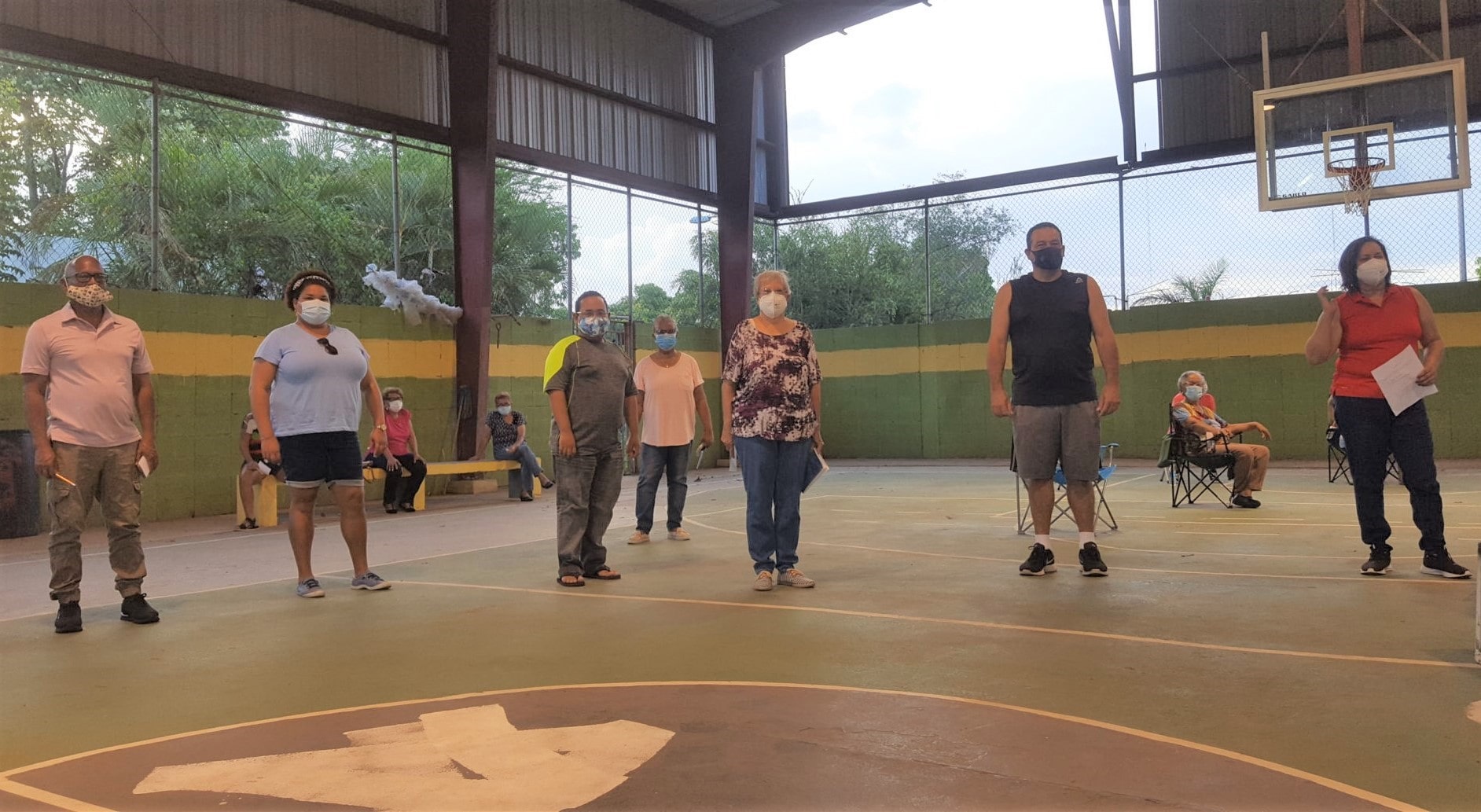
San Juan | Tuesday, April 27, 2021 | The Residents Association of La Margarita (ARLM), in Salinas, is venturing into becoming a solar community under the cooperative model, inspired by the achievement of self-management and community empowerment of communities that have transitioned to solar on the island. For a period of six months, the Puerto Rico Community Foundation (FCPR) will offer technical assistance and guidance in the process that will enable them to become owners of their own energy.
Both parties signed a collaborative technical assistance agreement that includes guidance on legal support, governance, economic sustainability, administration, empowerment, community organization, and promotion and strengthening of community participation. The ARLM will carry out community organization efforts and search for financing and philanthropic investments that will allow the construction of a micro-grid of renewable energy.
“We are very excited and hopeful about the beginning of this stage in the process of becoming owners of our own energy, while protecting our planet. We know there is a long way to go, but we are willing to go step by step to improve the quality of life in our community. The example of these solar communities shows us that it is possible,” said Wanda Janet Ríos Colorado, president of the ARLM.
Following the aftermath of Hurricane Maria, the FCPR added access to renewable energy to its strategic plan. The portfolio of projects in this area includes Toro Negro, in Ciales, the first solar community that owns and manages a solar system; Pirucho Coop., in Caguas, the first solar community certified as a renewable energy cooperative by the Puerto Rico Energy Bureau (NEPR); and Esperanza Village in Juncos, the first microgrid certified by NEPR. Other projects with access to renewable energy include: 37 primary health centers, six community aqueducts, a hydroponics center, three mobile renewable energy systems, 30 residences in Loíza, and 5 community resilience centers.
“Strengthening human and social capital is essential for the development of community projects like this one, and with this collaborative technical assistance agreement, we can contribute to that goal. La Margarita joins all these communities that have accepted the challenge of self-management and community empowerment to improve their quality of life, beginning to paint an increasingly resilient and environmentally friendly Puerto Rico, and Fundación Comunitaria is there to support them,” said FCPR President and Chief Executive Officer, Dr. Nelson I. Colón Tarrats.
On the other hand, FCPR actively works in the island municipality of Culebra to provide solar energy infrastructure, thanks to contributions from the Economic Development Administration (EDA) and philanthropic investors such as Global Giving and Prudential. Additionally, it collaborates closely with community aqueducts to provide similar infrastructure to the 242 that exist in Puerto Rico, funded by grants from the Central Office for Recovery, Reconstruction and Resilience (COR3), under the Risk Mitigation program of the Federal Emergency Management Agency (FEMA). FCPR is also part of a team promoted by the Rocky Mountain Institute, Rockefeller Foundation, and Resilient Power Puerto Rico, for the development of the Puerto Rico Community Energy Resilience Fund. Furthermore, it is conducting a feasibility study, co-financed with the Segarra Boerman Foundation, to explore the potential of a Community Energy Corridor in the Central Zone of Puerto Rico.