

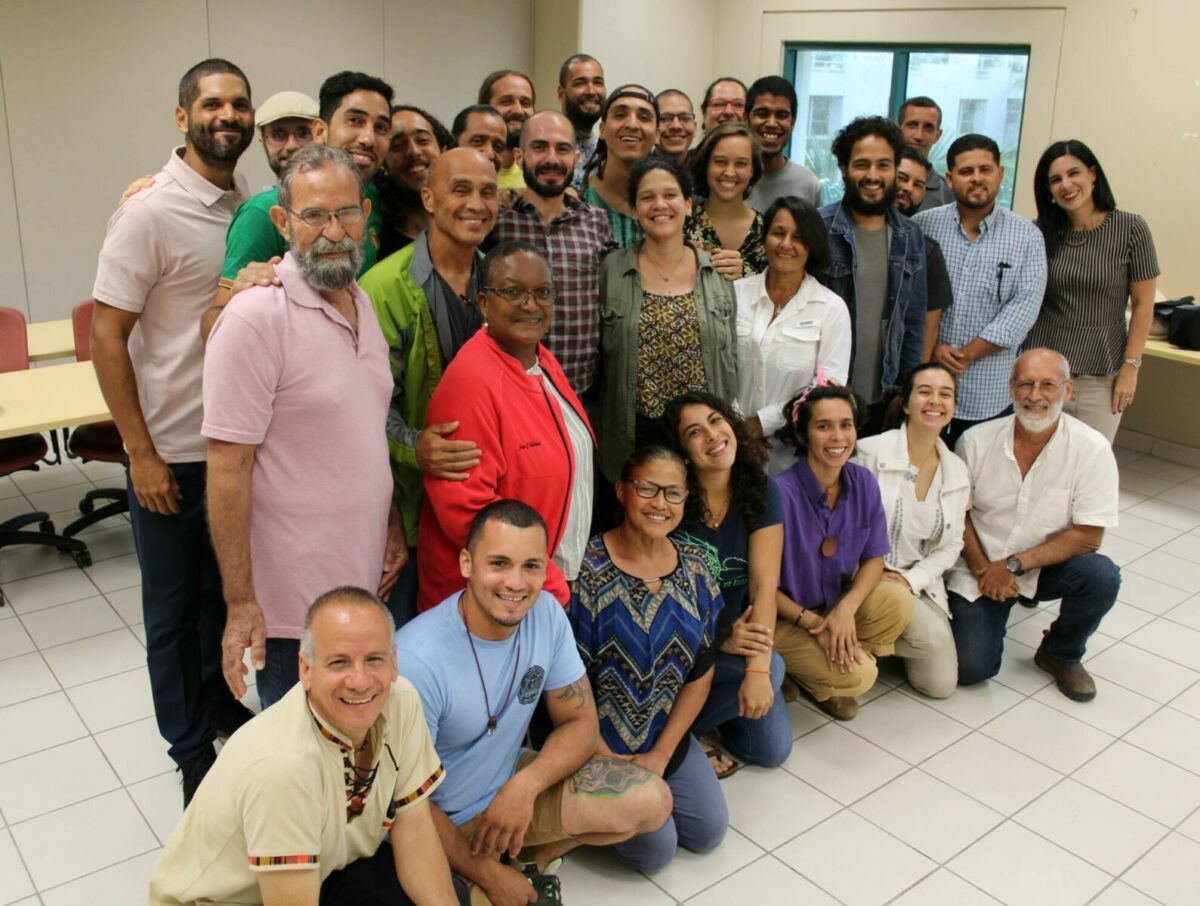
San Juan, Tuesday, December 3, 2019 A group of 34 farmers completed yesterday the first cycle of training in solidarity business self-management offered in Puerto Rico for micro-agroecological businesses, with the aim of developing or strengthening them. The training cycle was made possible by Fundación Comunitaria de Puerto Rico (FCPR), in collaboration with the Institute for Agroecological Research and Action, and part of the project initiatives Empowering Communities to Stimulate Economic Activity from FCPR, focused on stimulating sustainable development and solidarity entrepreneurship on the Island.
Participants gained knowledge about: from idea to business model, feasibility analysis, business plan, entrepreneurial self-esteem, legal forms of organizing a microenterprise, incentives, and financing options, among other topics.
“The course was a perfect fit for me. I am a high school teacher of Social Studies, an agroecological promoter, and a permaculture designer, and those last two are my strongest tools for carrying out the service of Home Gardens. But I realized something was missing, and that was how to create a good business model. That's what I gain from the training. With a business plan, I can approach financial institutions to possibly request financing and secure seed money to launch my company. I want my company to grow and hire employees,” said Braulio Morales, a participant and owner of Huertos a Domicilio, a business that builds gardens in the metropolitan area.
Some of the agroecological projects that are being developed or strengthened are: Restorative Food, preparation and sale of veggie burgers with products from agroecological farms; Earth filter, Water filters made of clay; Red Gold Farm, offer of glamping (glamping); Rios Organic Farm y El Algarrobo Farm, agricultural production farms; and the Project Cabachuelas, focused on offering an ecotourism, educational, and community-based alternative in the Las Cabachuelas Natural Reserve in Morovis. “The training cycle for these farmers arises from an initiative by the Puerto Rico Community Foundation, which seeks to strengthen the human capital of the participants by granting them access to business knowledge, with a solidarity perspective, so that they can elevate their agroecological businesses to the next level,” said the president of the Community Foundation, Dr. Nelson I. Colón Tarrats.
The 34 participants, whose average age is 39, are members of the Boricua Organization and the El Josco Bravo Agroecological Project, organizations grouped under the non-profit entity Institute for Research and Action in Agroecology. In addition to collaborating with this initiative, the Institute has received training from FCPR to promote the self-management of solidarity-based agroecological projects, such as those covered by this certification. “To achieve a real agroecological transformation in Puerto Rico, it is essential to transform the knowledge and will of hundreds of young people who are returning to the land into profitable and successful projects. This will pave the way for the mass adoption of a new agriculture and Puerto Rican food sovereignty,» stated Ian Pagán, coordinator of the El Josco Bravo Agroecological Project.
The project is financially supported by Center for Disaster Philanthropy and the training was offered by Nelson Reyes-Del Valle, a specialist in community solidarity economy and co-founder of ConsultCom, using his Solidarity Community Microenterprise Incubator (iMECs) model.
#
About the Puerto Rico Community Foundation |A nonprofit entity that for 34 years has advised individuals, families, corporations and foundations on and off the island on how to channel their philanthropic concerns. The advisory seeks to ensure that donors' contributions have an impact on the self-development of Puerto Ricans. In addition, FCPR's strategic plan promotes equitable and sustainable access to clean water, renewable energy, housing, economic development and education. The FCPR is the first foundation of its kind in Puerto Rico and the Caribbean, and today the only one in Puerto Rico.