

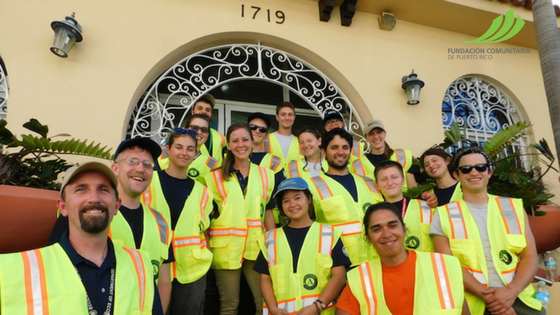
Sitting in a semi-circle in the parking lot at the back of the Puerto Rico Community Foundation, more than a dozen young people discussed the work agenda for the next day.
They were wearing T-shirts, cargo pants and boots. They had already stored their work tools in one of the institution's storerooms. From chainsaws, scissors and even machetes. As well as other highly coveted tools in post-Hurricane Maria Puerto Rico.
These young people are part of the AmeriCorps Disaster Response Team (A-DRT). The team was activated in early October for specific assignments to clear roads, remove debris and cut down trees that had fallen on homes. They also visited homes to identify fungus-related problems.
Initially, the work brigades concentrated on municipalities in the southern zone and San Juan. However, by the end of December they would have reached other areas of the island.
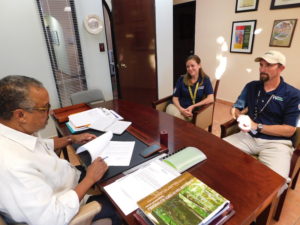
During the months following Hurricane Maria, the Community Foundation became the center for the storage of the equipment of this volunteer corps. It also became the place where, at the end of the work day, these young people followed a strict hygiene protocol for their personal hygiene, so that they could eliminate from their bodies any pesticide residue or contaminant that could put their health at risk.
Shari Orr, Management and Program Analyst Office of Field Liaison, mentioned that the A-DRT team also has groups of volunteers working with logistics and distribution of supply donations. «We are working with a variety of partners on the Island, organizing relief and groceries for immediate distribution in the communities.».
The A-DRT is made up of 16 programs from all over the United States that are responding to FEMA's call for disaster relief efforts. Including a small team of eight people stationed at FEMA warehouses in Jacksonville, Florida, working with the shipment of aid to the island.
«Some of our missions started with 14-day assignments. However, it was too short to make a real impact in the community, so we asked for 30-day assignments,» explained Rob Crawford, executive manager of A-DRT, who is also with the Washington State Conservation Corp.
In this way the volunteer brigades, including the staff, remain on the island for a month and are then replaced by other brigades, allowing them to rest and possibly return for the next round.
For Crawford, who was active during the four hurricanes that hit Florida in 2004 and during Hurricane Katrina, the devastation caused by Hurricane Maria on the island was similar.
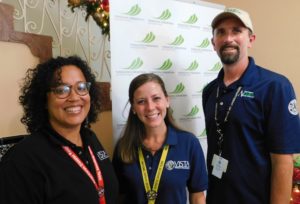
Kenia Colón, who lives in Puerto Rico and helps coordinate the work of these volunteers from here, was very active in the months following the hurricane. Kenia recalled that along with the first wave of volunteers, they tried to understand the state of the situation [in the country] to determine where AmeriCorps teams could be most effective. However, they quickly understood that the damage was extensive and the impact had been island-wide. So the priority was to establish a working strategy to address the situation with the available resources.
Crawford highlighted the connection that exists in the communities of Puerto Rico, even in the midst of the devastation. According to him, one could notice the mutual support that neighbors and community members gave each other, in some cases he observed how people put their own needs first to give priority to other neighbors who they understood were in worse conditions. Orr commented that «the response [from the communities] was always warm and friendly to the A-DRT teams, despite their frustrations at the loss of belongings and jobs.
«Having local resources has been essential to reach the hardest-hit areas,» Crawford noted, as it was this valuable direction that allowed them to focus aid on the most vulnerable locations.
Some of the brigades that have been working on the island:
Washington State Conservation Corp. with a team from California (12 members) were working in Ponce - team has experience with fires and working with chainsaws. In addition, they have experienced teams to remove trees, as they have professional sawyers.
California Conservation Program and Conservation Corp Minnesota-Iowa- were in Ponce. Both brigades have bilingual staff. This has been very helpful in interacting with the homeowners.