

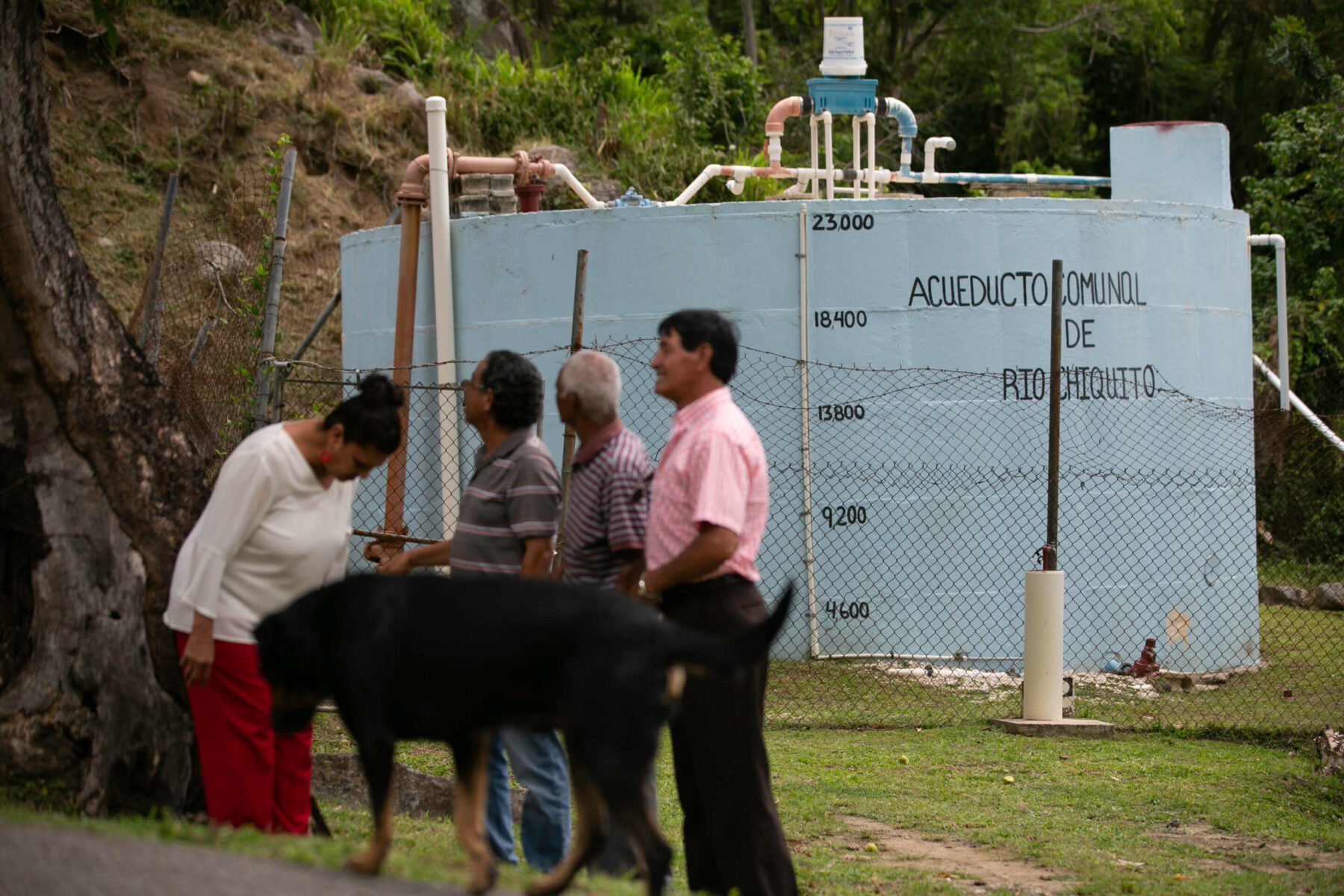
The community mission and social responsibility axes of analysis at the Pontifical Catholic University of Puerto Rico.
Press release generated by the PUCPR
(Ponce, Puerto Rico - October 23, 2018) After the emergency that Puerto Rico experienced in the aftermath of Maria, the spirit of solidarity and community support emerged with great force. But, as we turn the page and continue the recovery process, how can we sustain and strengthen this solidarity effort in the communities?
According to Dr. Nelson Colón Tarrats, president of the Puerto Rico Community Foundation, “María generated a unique, supportive and all-encompassing gesture. María now provokes in us a look of equal access, under the same conditions, to the resources of life. But this idea must last forever, because part of the challenge is not to get used to these accesses to water, electricity, health and life being interrupted. The specialist in education, anthropology, community development and philanthropy presented a lecture on the following topics Spontaneous“ community efforts, how can they be articulated and sustained? as part of the fourth cycle of conferences organized by the Social Responsibility, Transparency and Integrity Project (ReSTI) of the Pontifical Catholic University of Puerto Rico (PUCPR).
As strategies to sustain these efforts spontaneously, it is vital to create a sense of belonging and collective ownership among citizens. “This is ours, the essential services are ours. That axis of people becoming active, participating and becoming owners is an opportunity, a seed of hope that Maria opened. We are looking for that leadership, empowerment, strengthening and internal community organization, and to capitalize on them. This produces a great ‘glue’ of solidarity when working in a mutual focus,” he emphasized.
As an example, Colón Tarrats explained a solar energy project that he developed, together with the Foundation, a community in the Toro Negro area of Ciales. “Why don't we design a solar community in Puerto Rico where the neighbors are the owners? Toro Negro was 11 months without electricity and they became the first solar community. Through 7 microgrids, 25 families energized 85 people. The community owns and manages the renewable energy system. They all agreed, had the leadership and organization. Now they have their own electric power system”.
Likewise, the president of the Puerto Rico Community Foundation emphasized the need to identify the needs and capacities in the communities in order to bring about change. “Part of the work of the universities is to make approaches to look for opportunities. Where are the needs, where are the capacities to work in the different areas, and where is the meeting point to achieve this?.
Efraín O'Neill Carrasquillo, professor of electrical engineering at UPR Mayagüez, joined in this analysis. “The issue of the survival community is fundamental, particularly in this recovery process. This is a lesson we cannot forget and we have to strengthen the role of the communities.” In fact, he spoke about the importance of training communities to take a leading role in meeting basic needs. “In these skills the universities have a lot to do. At the Mayagüez campus of the UPR, for example, we are working on the concept of oasis of light. Through donations, we installed 5 small solar systems in different parts of Puerto Rico. It was a very valuable initiative that we hope will serve as a model for other communities,” said O'Neill Carrasquillo.
The civic vocation, the community mission, the ecological vision, the social meta-ethics of professional ethics and university social responsibility are the five discussion focuses that make up the lecture series on social responsibility. The fourth runs through January 2019. For information, please contact 787-841-2000 ext. 1620/1623 or at isnapa@pucpr.edu
70th Anniversary of great transformations
The Pontifical Catholic University was founded in 1948 at the initiative of the bishops of Puerto Rico: Bishop James E. McManus, C.S.S.R., Bishop of the Diocese of Ponce and Bishop James Davis, Bishop of the Diocese of San Juan. In the spring of that year the bishops announced to the people of Puerto Rico the founding of the Catholic University although it was initially named Santa Maria. This year the PUCPR celebrates its seventieth anniversary.
All of its academic programs are accredited by the General Board of Education, the Middle States Association of Colleges and Schools, the Council on Higher Education, the Sacred Congregation for Catholic Education in Rome, and by various professional associations, such as the Accreditation Commission for Education in Nursing (ACEN), the National Accrediting Agency for Clinical Laboratory Sciences, the Council on Social Work Education, and the American Bar Association. It is an independent, autonomous, not-for-profit, coeducational institution of higher education.
The Pontifical Catholic University of Puerto Rico has campuses in Ponce, Mayagüez and Arecibo. It serves young and adult students of different creeds, races, nationalities and economic levels. It contributes to the formation of the country's human resources, in accordance with the needs of society and the development of education.